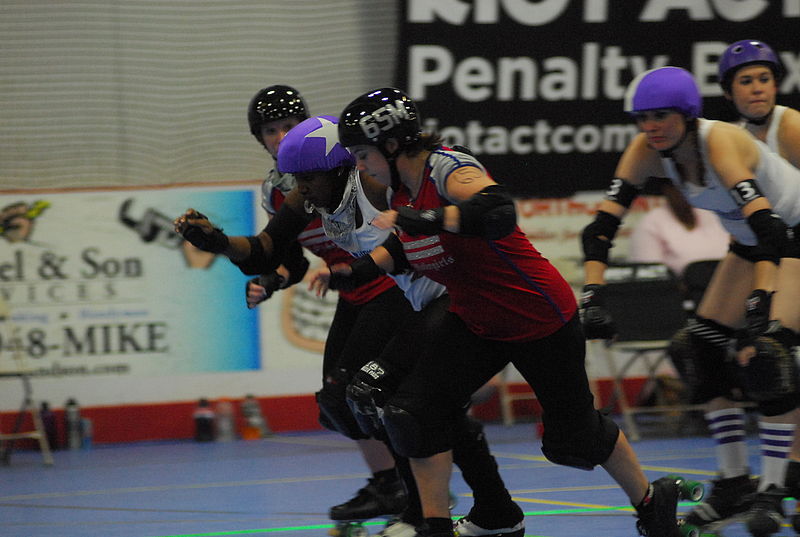
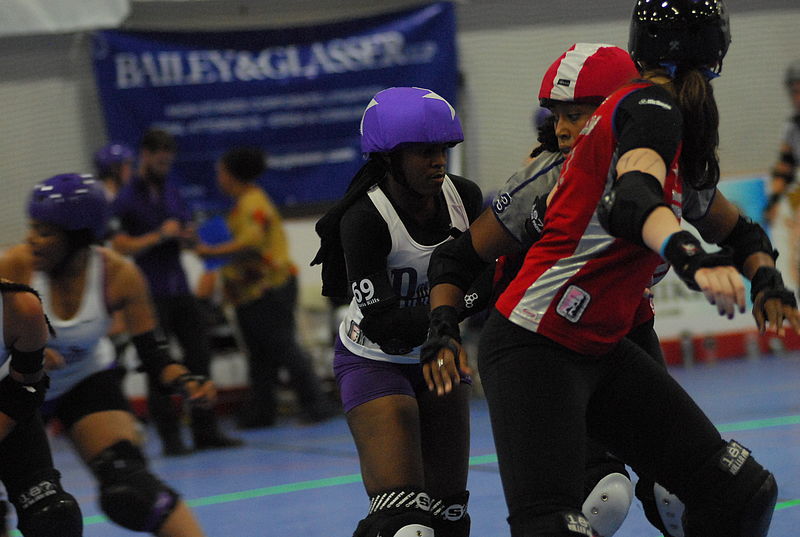
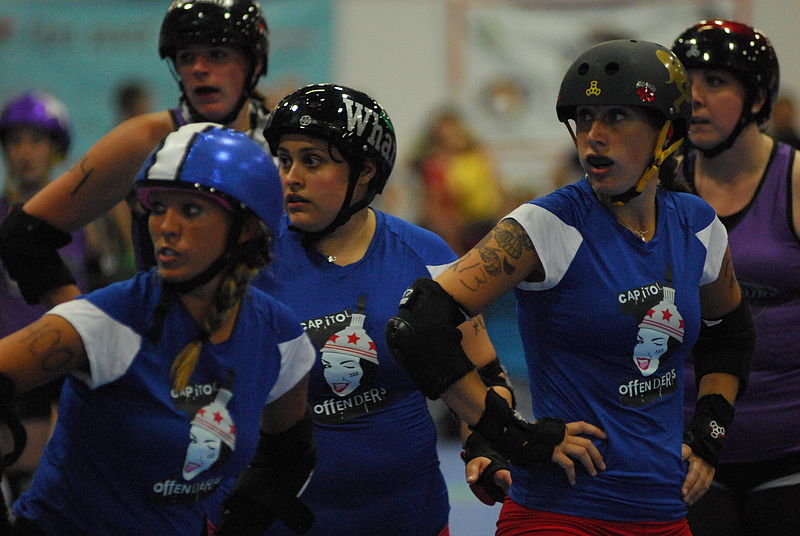
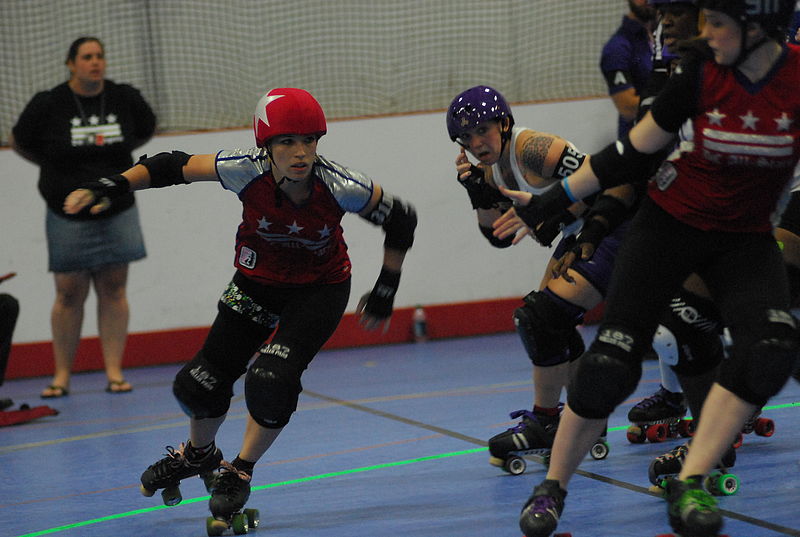
Total team mis-match. Salisbury All-Stars creamed the Capitol offenders by a huge margin, displaying defensive tactics that were simultaneously highly effective and very painful to watch executed. Similarly, the DC All-Stars had such good offensive strategy that they were able to short circuit Poe's Punishers, at least in the first quarter I was there. (Who won? I wonder.)
Mountains
Sunday, July 29, 2012
Friday, July 27, 2012
Jumped the Shark
You know the internet is no longer the in thing when people list "surfing the web" among the activities they look foward to enjoying in retirement.
Saturday, July 21, 2012
Tickets but No Train
One of the little rules about the zeitgeist is that you can find yourself contributing without knowing that it's there, and that's because you are the one making it.
It appears that sometime between the time the I lived in Dover and my friends were deciding to saving a few bucks out of every paycheck to pickup 1970's and 80's japanese motorcycles, and the time I got my license, those motorcycles got popular with the baby boomers again. The prices look to have nearly doubled as empty nesters custom shops decide to pick them up to either ride stock, or convert to cafe racers. They're still cheaper than new, but for the time being, finding a titled running honda cb450 for less than $2000 is a pipe dream. My friends were finding them for less than $1000 (I think one payed $450 the red CB350? (laser illuminated)).
The other (more romantic) idea was to hunt down a Genuine Stella 4t, and then we could go for substantially longer scooter adventures.
Of course, if we were trying to save money, we'd be doing none of this. The volvo is cheaper to run for a year than the lot of them.
It appears that sometime between the time the I lived in Dover and my friends were deciding to saving a few bucks out of every paycheck to pickup 1970's and 80's japanese motorcycles, and the time I got my license, those motorcycles got popular with the baby boomers again. The prices look to have nearly doubled as empty nesters custom shops decide to pick them up to either ride stock, or convert to cafe racers. They're still cheaper than new, but for the time being, finding a titled running honda cb450 for less than $2000 is a pipe dream. My friends were finding them for less than $1000 (I think one payed $450 the red CB350? (laser illuminated)).
The other (more romantic) idea was to hunt down a Genuine Stella 4t, and then we could go for substantially longer scooter adventures.
Of course, if we were trying to save money, we'd be doing none of this. The volvo is cheaper to run for a year than the lot of them.
Balance
I took the MSF safety class last weekend. Almost completely by whim. I was looking at the course schedule, saw it had a free seat, and whipped out the plastic talisman, and there I was in the classroom friday night. Plastic magic. The classroom was filled almost exclusively with young men. They showed us videos, lectured a bit, and answered a few awkward questions. It reminded me of sex ed. Except we got to practice the next day. Viva la difference.
A portion of the course was unremarkable, really. The mechanics of a motor vehicle are remarkably similar across the board. Engine. Clutch. Brakes. Gears. I had not really thought hugely about the physics, which the other portion was about. They never mentioned physics or talked about it much, but that's what it was.
I had not really paused to consider how a motorcycles center of mass, traction, and weight transfer characteristics are different from cars, bicycles, and motorscooters. They all have more stopping power with the front wheels, but the spectrum is surprisingly wide, with motorcycles being on the rear-brake-is-useless end and bicycles and some scooters on the -completely-possible-to-forgo-back-brake end. (I'd be fair to unicycles and put them in the middle). The major implications of this had been lost on me until the class:
1) it's very hard to stop a motorcycle in a curve
2) front brake is massively destabilizing at low speed and in curves, and
3) motorcycle back brake has different lockup rules than other vehicles (If you lock up, keep it that way until you stop...)
There had been quite a few practice rides in parking lots (directed by the girly) with the Motorpickle (a Genuine Buddy 125). I practiced low speed turns, swerves, leans, and hard stops quite a bit. That all proved mostly useful, except for the braking, which may have been detrimental to the MSF course, where I was on a actual motorcycle. The Buddy has a low center of mass with the engine below and behind the rider over the rear wheel, with the seat on the gas tank. A motorcycle has it in front of the rider, between the knees, with a gallon of gas perched on top. Between the motorpickle and the endless hours of bicycle commuting, I organically expected a certain braking dynamic. I expected the rear brake to feel sluggish but effective and forgiving in draining speed, and to tend to pull the front end into the direction of lean, and the threshold before a lockup is large. I expect the front brake to be a better stopping force, and it's use does not substantially impact the bikes stability. In contrast, the rear brake on the motorcycle seemed to lock up far too soon, it bleeds speed very gently, but has no capacity and little range. The front brake felt almost grabby. Using it in a hurry, particularly at low speeds, initiated some frightening dives that were highly destabilizing if in a turn. After the first day on the range, I spent the rest of the day trying to mentally retrain my mindset for the new vehicle. Easy on the front brake. To slow just a bit, use the rear. Use both calmly to stop when upright. The emphasis on gentle is a contrast to my bicycle style, where I use lots of hard braking to keep my precious, hard earned velocity until the last moment, and my center of balance is very very fluid, even with 50 lbs of groceries.
I'm a science wonk, I'm used to thinking about things in terms of force, friction, acceleration, velocity, inertia, and center of mass. The class wasn't in those terms. (Heck, why not just print this out for people? I guess the math isn't as fun as doing it.)
To me, taking a curve is leaning to balance the force of gravity against the centrifugal force on my center of mass. To make that happen, it helps to steer the bikes wheels out from underneath to setup the lean. Accelerating in the turn helps with the stability. The course said: slow, look into the turn, push the handlebars that way, then roll on the gas. We got a lot of instructions that, but not a lot of discussion of what was happening. Derivation left as an exercise to the r(ea/i)der.
Regardless of the form the instruction (really, it needs to be usable to a large group of people), it was the best way to get the license. Riding a motorcycle is not something that can be just made up as one goes along in dense urban areas. There's a right way to do things, and a lot of wrong ways. It was totally worth the time and money.
A portion of the course was unremarkable, really. The mechanics of a motor vehicle are remarkably similar across the board. Engine. Clutch. Brakes. Gears. I had not really thought hugely about the physics, which the other portion was about. They never mentioned physics or talked about it much, but that's what it was.
I had not really paused to consider how a motorcycles center of mass, traction, and weight transfer characteristics are different from cars, bicycles, and motorscooters. They all have more stopping power with the front wheels, but the spectrum is surprisingly wide, with motorcycles being on the rear-brake-is-useless end and bicycles and some scooters on the -completely-possible-to-forgo-back-brake end. (I'd be fair to unicycles and put them in the middle). The major implications of this had been lost on me until the class:
1) it's very hard to stop a motorcycle in a curve
2) front brake is massively destabilizing at low speed and in curves, and
3) motorcycle back brake has different lockup rules than other vehicles (If you lock up, keep it that way until you stop...)
There had been quite a few practice rides in parking lots (directed by the girly) with the Motorpickle (a Genuine Buddy 125). I practiced low speed turns, swerves, leans, and hard stops quite a bit. That all proved mostly useful, except for the braking, which may have been detrimental to the MSF course, where I was on a actual motorcycle. The Buddy has a low center of mass with the engine below and behind the rider over the rear wheel, with the seat on the gas tank. A motorcycle has it in front of the rider, between the knees, with a gallon of gas perched on top. Between the motorpickle and the endless hours of bicycle commuting, I organically expected a certain braking dynamic. I expected the rear brake to feel sluggish but effective and forgiving in draining speed, and to tend to pull the front end into the direction of lean, and the threshold before a lockup is large. I expect the front brake to be a better stopping force, and it's use does not substantially impact the bikes stability. In contrast, the rear brake on the motorcycle seemed to lock up far too soon, it bleeds speed very gently, but has no capacity and little range. The front brake felt almost grabby. Using it in a hurry, particularly at low speeds, initiated some frightening dives that were highly destabilizing if in a turn. After the first day on the range, I spent the rest of the day trying to mentally retrain my mindset for the new vehicle. Easy on the front brake. To slow just a bit, use the rear. Use both calmly to stop when upright. The emphasis on gentle is a contrast to my bicycle style, where I use lots of hard braking to keep my precious, hard earned velocity until the last moment, and my center of balance is very very fluid, even with 50 lbs of groceries.
I'm a science wonk, I'm used to thinking about things in terms of force, friction, acceleration, velocity, inertia, and center of mass. The class wasn't in those terms. (Heck, why not just print this out for people? I guess the math isn't as fun as doing it.)
To me, taking a curve is leaning to balance the force of gravity against the centrifugal force on my center of mass. To make that happen, it helps to steer the bikes wheels out from underneath to setup the lean. Accelerating in the turn helps with the stability. The course said: slow, look into the turn, push the handlebars that way, then roll on the gas. We got a lot of instructions that, but not a lot of discussion of what was happening. Derivation left as an exercise to the r(ea/i)der.
Regardless of the form the instruction (really, it needs to be usable to a large group of people), it was the best way to get the license. Riding a motorcycle is not something that can be just made up as one goes along in dense urban areas. There's a right way to do things, and a lot of wrong ways. It was totally worth the time and money.
Saturday, July 7, 2012
Lessons Learned: Disaster Preparedness in the Big City
The recent mass-power outage and heat wave was the second demonstration in less than a year of the weaknesses of the support system in D.C. and large cities in general. Based on my experience with these two events and a few snow storms, I've come to some conclusions about emergency preparedness here, and long term limited access to electricity.
In particular:
(1) In the event of a regional emergency, the roads will be impassable.
There is no evacuation plan for the DC area. In the snowstorm of 2010, everyone got trapped during rush hour. Everyone was sent home from work after the earth quake, creating an epic traffic jam as people tried to get home and get to their kids. After the Derecho, the power was out, the heat was oppressive, and no one knew it was -everywhere-, so the roads, without traffic lights, were jammed with cars packed with people thinking they could go out for breakfast or the mall for some A/C. The lesson is that the extant DC area transit crisis is amplified many fold when people take to the streets in conditions that are beyond routine. Attempting travel during these times is likely to be fruitless at best, and more risky at worst.
Point: If something bad happens, you need to be able to shelter in place.
This means having some clothes and munchies stashed at work, and enough supplies to survive at home for ~48 hours without power and without leaving.
(2) Communication and information availability will be poor.
Both personal and regional communication channels are limited in comparison with the size of the population. With large proportions of households using non-traditional telephony (e.g. phone through FiOS, cable, or no landline at all), personal communication channels are easily overwhelmed. During power outages, FiOS and Cable simply don't work, and their internet connections are disabled as well. This leaves the cellular network as the only means of communication, and there is not enough capacity to handle the increased demand. During all three events, it was nearly impossible to send access the internet, call, or send text messages, at least initially. I think after the 'shock' wears off the general populous, usage drops. Your cellphone may be your only method of communication for some time. Modern radio stations do not provide highly detailed information as they did during the cold war, but you can use them to get a clue. You are likely to find yourself at home, in the dark, without having a complete status of the world.
Point: Make sure you have a battery powered radio, and a car charger for the cellphone.
(3) There will be unusual side effects
During the power outage, stores had no ice, but did have lots of generators. After the earthquake, the dog park was packed. After the snow storm, the roads ended up well cleared, and everyone was asked to go to work, even though most of the cars that had been abandoned were towed.
(4) The stuff in the freezer will have to go
Things in the fridge can be iced down in a cooler for a long time, but a cooler with ice won't help a frozen pizza for long. You'll have to either find a way to eat the frozen food, or it'll have to be thrown out. Sorry.
(5) Have a plan for cooking
Camp stove, sterno, grill, something. Think about ventilation too. CO poisoning is always a problem. While during the power outage it was possible to go out to eat at restaurants after the first few days, it is fairly costly, so cooking at home remains appealing, especially considering all that food you're trying to keep cool in the cooler.
(6) Have a plan for lighting
A couple of flashlights are handy for short term outages, but if you find yourself in the dark for a few nights in a row, candles, a larger lantern (gas or electric) for area lighting makes things seem a lot more comfortable.
(7) The elements are going to get harsher
Once the power goes out, your abode is going to be at the mercy of the weather. A few lucky people are going to have woodstoves for heat in the winter. Cooling becomes a major problem, as modern houses and apartments are not meant to be comfortable without mechanical assistance. Think about what you're going to do to manage as things heat up for freeze. A fan that can run on batteries for the summer and a heavy blanket or sleeping bag for winter.
In particular:
(1) In the event of a regional emergency, the roads will be impassable.
There is no evacuation plan for the DC area. In the snowstorm of 2010, everyone got trapped during rush hour. Everyone was sent home from work after the earth quake, creating an epic traffic jam as people tried to get home and get to their kids. After the Derecho, the power was out, the heat was oppressive, and no one knew it was -everywhere-, so the roads, without traffic lights, were jammed with cars packed with people thinking they could go out for breakfast or the mall for some A/C. The lesson is that the extant DC area transit crisis is amplified many fold when people take to the streets in conditions that are beyond routine. Attempting travel during these times is likely to be fruitless at best, and more risky at worst.
Point: If something bad happens, you need to be able to shelter in place.
This means having some clothes and munchies stashed at work, and enough supplies to survive at home for ~48 hours without power and without leaving.
(2) Communication and information availability will be poor.
Both personal and regional communication channels are limited in comparison with the size of the population. With large proportions of households using non-traditional telephony (e.g. phone through FiOS, cable, or no landline at all), personal communication channels are easily overwhelmed. During power outages, FiOS and Cable simply don't work, and their internet connections are disabled as well. This leaves the cellular network as the only means of communication, and there is not enough capacity to handle the increased demand. During all three events, it was nearly impossible to send access the internet, call, or send text messages, at least initially. I think after the 'shock' wears off the general populous, usage drops. Your cellphone may be your only method of communication for some time. Modern radio stations do not provide highly detailed information as they did during the cold war, but you can use them to get a clue. You are likely to find yourself at home, in the dark, without having a complete status of the world.
Point: Make sure you have a battery powered radio, and a car charger for the cellphone.
(3) There will be unusual side effects
During the power outage, stores had no ice, but did have lots of generators. After the earthquake, the dog park was packed. After the snow storm, the roads ended up well cleared, and everyone was asked to go to work, even though most of the cars that had been abandoned were towed.
(4) The stuff in the freezer will have to go
Things in the fridge can be iced down in a cooler for a long time, but a cooler with ice won't help a frozen pizza for long. You'll have to either find a way to eat the frozen food, or it'll have to be thrown out. Sorry.
(5) Have a plan for cooking
Camp stove, sterno, grill, something. Think about ventilation too. CO poisoning is always a problem. While during the power outage it was possible to go out to eat at restaurants after the first few days, it is fairly costly, so cooking at home remains appealing, especially considering all that food you're trying to keep cool in the cooler.
(6) Have a plan for lighting
A couple of flashlights are handy for short term outages, but if you find yourself in the dark for a few nights in a row, candles, a larger lantern (gas or electric) for area lighting makes things seem a lot more comfortable.
(7) The elements are going to get harsher
Once the power goes out, your abode is going to be at the mercy of the weather. A few lucky people are going to have woodstoves for heat in the winter. Cooling becomes a major problem, as modern houses and apartments are not meant to be comfortable without mechanical assistance. Think about what you're going to do to manage as things heat up for freeze. A fan that can run on batteries for the summer and a heavy blanket or sleeping bag for winter.
Tuesday, July 3, 2012
Blackout
The storms of last friday, which the meteorologists are gleefully bubbling about, successfully convinced a large tree to launch itself across the neighborhoods power lines, severing both high voltage and local loops, and left us and about 3 quadrillion other people in the dark. It turns out that not having electricity gets annoying pretty fast in the modern world. It's worse than simply not having the Xbox work, no internet, and all the food in the fridge go bad. Those are all pretty easy to deal with. The part that is really miserable is that that a modern house becomes nearly unbearable without active climate control mechanisms. They become hot, dark, and stuffy fast, especially in the absence of a breeze. If the blackout was a permanent thing, our place would be worthless. I am surprised at how poorly it adapts to a dark world. Everything seems wrong. Their are too few windows. The ceilings are too low. There is too little porch, and the eves don't reach out far enough.
I now have some new insights about design and architecture. If you could build a house that could be livable without electricity, it would be cheaper and more efficient to live in by default. This is not obvious when energy seems free.
Time to go back to the dark.
Subscribe to:
Posts (Atom)