Mountains

Mountains

Friday, January 2, 2015

Death's Proclivities


Death really likes Pizza, but has no method of consumption.

Hammer Time: How I shattered a brake rotor with deadblow hammer

I broke a rear brake rotor with a deadblow hammer. As someone with a BMI of less than 20, I view that as a small life achievement.

Months later, my neighbours commented that it seemed really weird having my friend standing in the driveway talking on his phone while I worked on his car. Conversely, I remember it as me standing in the driveway wishing for more coffee while he worked on his car. Though I admit my hand was on the hammer when the rotor went to bits.

As to the backstory, my friends 2003 honda accord needed new rear brakes. The shop asked for a figure larger than $400, and my friend scoffed, bought the parts, then asked me to help him do the deed. How hard could 12 bolts be?

Very.

Turns out the cars life had led it to wet, salty places. The aluminum rims were rusted to the rotors. The rotors where rusted to the hubs. I doubt any of it had ever come apart. The wheel required hammering to remove. We had to drill the rotor set screws, use wire brushes in the dremmel to remove a 1/8" thick bead of corrosion, and lots of penetrating oil and hammering to get it off. So much hammering.

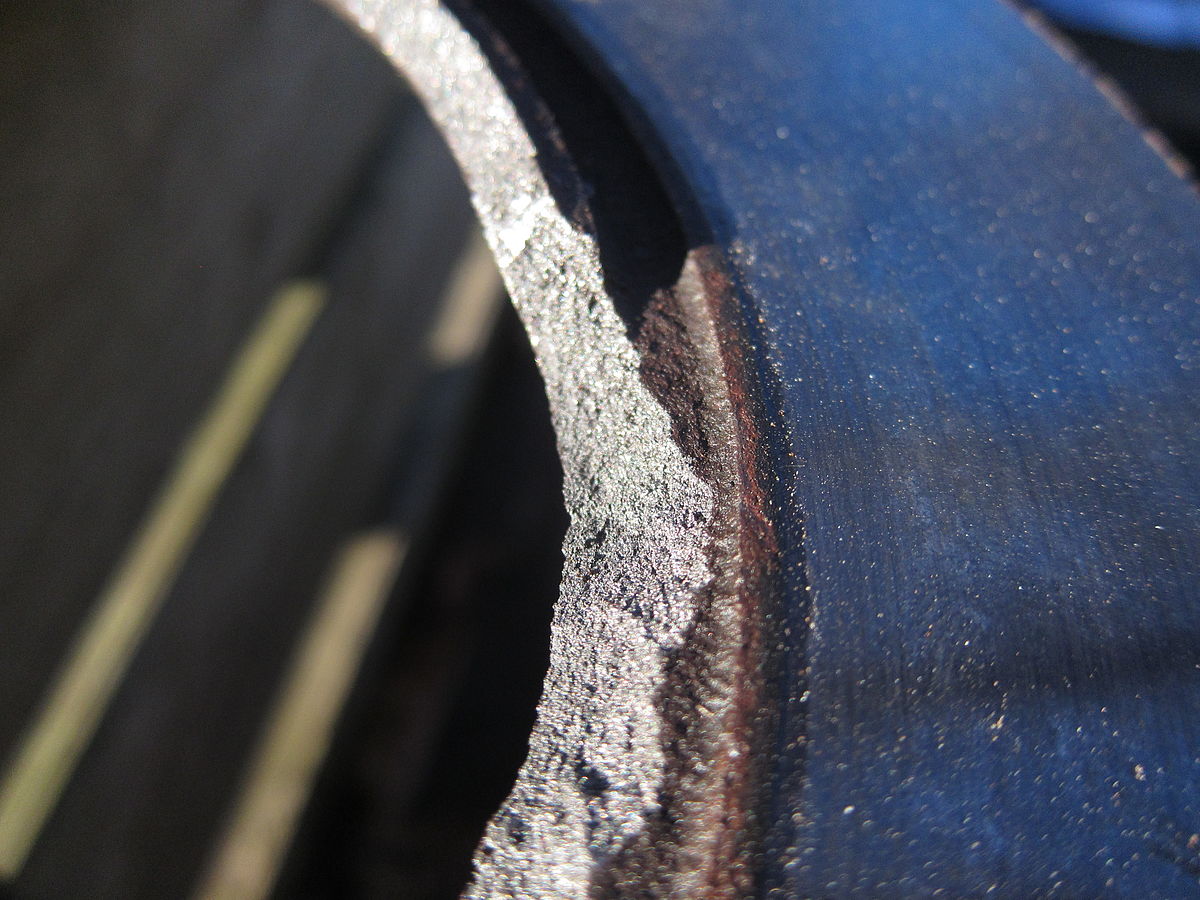
Looking for more leverage and not caring about surface of the rotor being removed (it was to be replaced) I hit the contact surface of one, and to my surprise, it snapped off the hub. The blow managed to defeat a 1/4" steel weld. Unimaginable. While I worried about the car being stuck in the driveway, I figured it all still had to come off, and kept working.

My friend drove home with new brakes that night.


The broken weld:

NoVa Roller Derby: August 2014 Double Header

I never posted these? Really? Life is cruel.

Backwoods Rollers against Metro Misfits:


Beltway Betties vs Vineyard Vixens:


Saturday, November 1, 2014

Lil' Wheezer: Fun with a Siezed Volvo Airbox Damper

Emissions controls on cars are great things, they keep cars from emitting vast quantities of pollutants that make breathing a miserable experience. They are also quite awful, since they add complexity to a vehicle, decreasing reliability, and, in some scenarios cause emissions to be worse than no controls at all.

Take, for example, the air damper in B230 and Volvo. The damper moves back and forth to control air coming from outside the car or from over the exhaust manifold, thus keeping the air entering the engine above ~55 degrees F but below whatever the exhaust temperature is. This is for several reasons. First, the computer apparently lacks an in air temperature correction, meaning that temperature extremes lead to inaccuracy in airflow estimations, which in turn, result in lean or rich running conditions (hurting economy and also making for worse emissions if not controlled). Second, without warmed air, ice can form in the intake under cold, humid conditions, causing intermittent failures. The downside to using a simple wax motor thermostat is that there is no indication if it fails, and, if it fails in the hotair only mode, it ends up making emissions much worse and will eventually kill the mass flow controller with the extremely hot air from over the exhaust manifold.

Like a lot of other people, I'd been wondering about some stuff my volvo 740 was doing. The fuel economy has been off since day one, and I noticed that the car got really really lazy when it was hot, and it tended to start to stumble a bit in traffic jams on warm days. Also, I was annoyed that it just barely passed emissions, with hydrocarbons being just a few ppm below failing.... So I decided to take apart the air box and test the thermostat.... It certainly didn't seem like it was working.


Getting the air box out was a bit of a chore. It's held into to the engine bay with a bunch of big silicon rubber grommets. They don't like to let go. Then the damper assembly is jammed into the side of the airbox, and requires some careful prying with screwdrivers to get some figures to unlock, then the friction between the conical assembly and the airbox housing must be overcome, all without snapping any 25 year old plastic. Fun times.


Freed of the housing at last, the thermostat was frozen at about 20% cold, 80% hot.

I dug through the parts drawer and found an equivalent shaped bolt and installed it in the airbox, and enjoyed a summer of powerful and smooth motoring.

The thermostats are pretty cheap. As I write this, there's one inbound from IPD volvo.

I'm considering putting a cheap mechanical thermometer in the airbox so I can check it more easily


Monday, August 25, 2014

Evil Aluminum Dog Bone: Care and Feeding of you GM A-Body

The ChevOldsmoBuiac, a 1990 Oldsmobile cutlass Ciera, kills it's torque strut mount every few years. The bushings in the mount, which are cast into the body of the aluminium strut, delaminate and crack, letting the Iron Duke rock back and forth a few degrees, causing the car to lurch into gear and sometimes surge oddly when cresting hills.

This is a bit of an annoyance. The original strut lasted for 15 years or so, and the subsequent 10 have seen 4 mounts. They're only a few dollars each, but it's silly to have that be a wearable part.


I have considered just filling in the cracks and gaps of the old mounts with silicone rubber, but at ~$4 each, the replacements are easy to swap and can be kept on hand as spares.

I've also thought about fabricating my own with more easily replaced bushings. I could drill an 2" aluminum bar and press in a few sway bar bushings. Those are commonly available at the autoparts store and could be easily replaced without waiting for shipping. But then, I'd have to actually make the thing.
So, I keep buying the same old strut mounts.

Old strut. Bushing bulging out of the sides:


New strut mount installed.

Side comparison, showing bulging at the ends.

Profile comparison. Cracks can bee seen around the cores of the old mount.

Comparing the cores up close.

New mount installed.

Spare Anchor 2396 struts (on top of monroe struts!). I have't paid for any of their kids college, but I have paid for a nice dinner.


A Small Difference in Stature: More on Volvo B230 oil filters

I buy oil filters for the cars from Rock Auto in bulk when on sale, and usually in conjunction with other parts. That way filters can be had for a few dollars each at most.

The current set of spares for the Volvo 740 (B230 I-4 engine) are motorcraft.

While the Motorcraft FL-332 filter does spin on as a replacement for the Mann W917, the Motorcraft, is is about 1/2 inch taller. The o-ring is in a slightly different location as well, so I cleaned the mount well to be sure no grit got entrained.

The date on the old filter is correct. The volvo is only driven a few thousand miles per year, so annual oil changes are something of a waste.